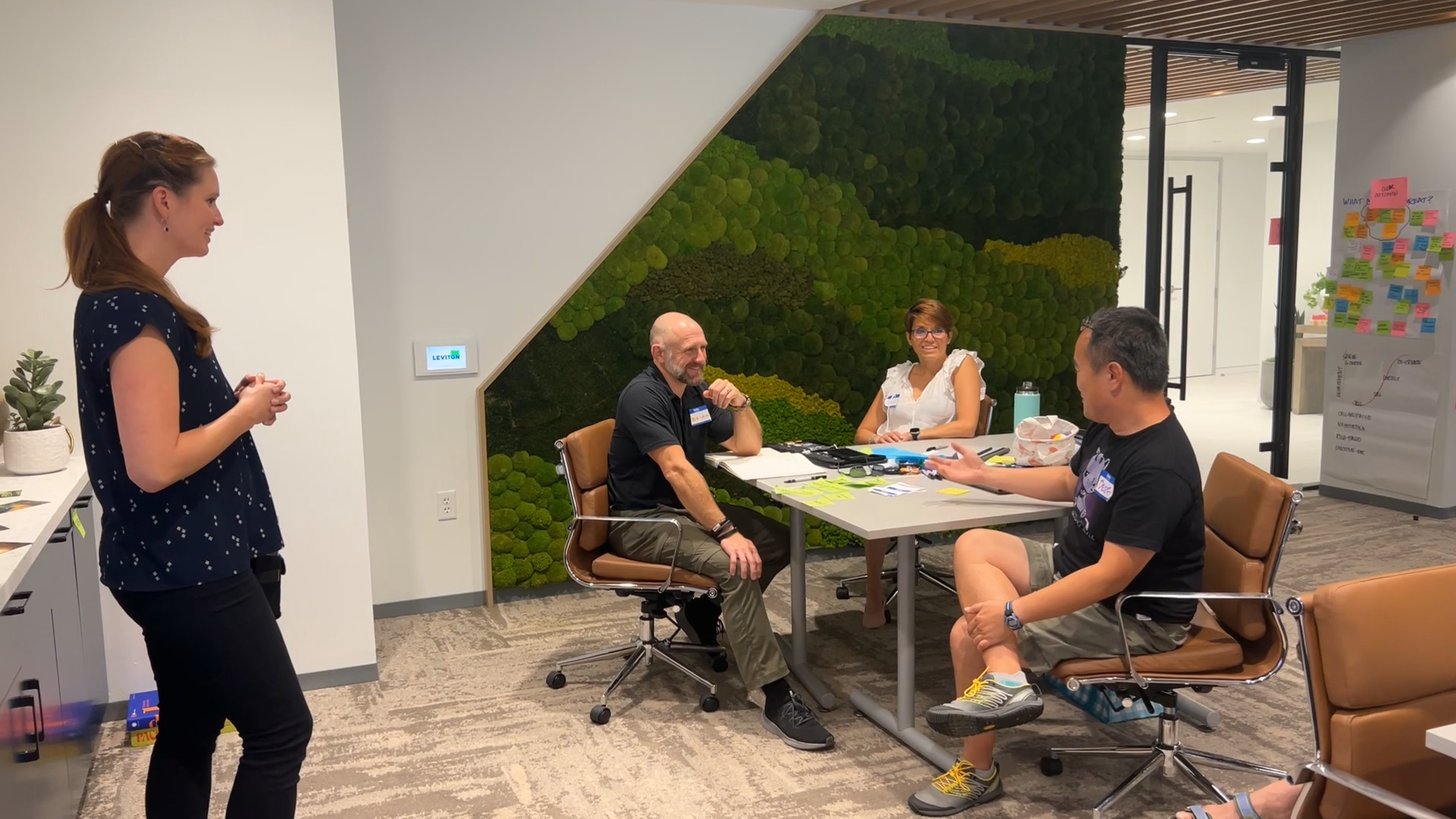
11 million meetings occur in the United States every day. People report that more than half of time spent in meetings is wasted.
Don’t Just Do Something, Stand There is a call to action to make every moment of our meetings count, an important goal today, especially for those working remotely, with fewer opportunities to meet and less time to accomplish our goals.
Marker in hand, I stand by my blank sheet of paper, ready to capture the first creative insight from the group.
The participants, 15 federal employees, have convened for a workshop on the art of innovation, commonly known today as “human-centered design.” The two facilitators, consultants from a large firm, are about 30 minutes into their agenda when things start to go off track.
“What are your key challenges?” one facilitator asks.
Several participants launch into a rant about all of the technology limitations they are facing. The facilitator scribbles each challenge on a sticky note, barely keeping up, frantically trying to keep the notes from piling up below the flipchart.
“Let’s turn that into a challenge question,” says the facilitator shakily. “How might we…”
He barely finishes the sentence before one participant asks, “How is this supposed to help us? It takes years to implement technologies in our environment. There’s no point in even trying.”
The facilitator’s voice cracks; fear crosses his face. The other facilitator steps in to try to explain the purpose of the exercise to a room of glazed faces.
This is an example of an experience I witness over and over: facilitators trying to force-feed processes to groups who need something else—someone to hear them, legitimize their concerns, and, in many cases, help them heal.
Novice facilitators trained only in design thinking methods are often caught off guard when group behavior “gets real.” They try to stick to the agenda, becoming increasingly anxious and less responsive to participants who often rebel. The worst thing a facilitator can do is shut down or start blaming participants.
In Don't Just Do Something, Stand There (2007), Marvin Weisbord and Sandra Janoff remind us of fundamental facilitation competencies and techniques that many practitioners no longer learn.
Before you put on your facilitator hat and put a group through a design thinking process, read this book and apply these insights. For tenured facilitators, this can serve as a reminder not to get caught in common pitfalls.
Control What You Can, Let Go of What You Can’t
Work with people as they are, not as you want them to be.
“Control the structure, and participants will take care of the rest.” Instead of trying to control how people act, focus on the meeting's structure. In doing so, we let go of unrealistic demands on ourselves, such as worrying about participants’ attitudes, agendas, status, etc.
As “structuralist” facilitators, we create spaces where participants can manage their own behavior. We do this through manipulating the elements of:
Group composition
Division of labor
Time
Space
Focus on goals
Sub-groupings
“Complex times call for simpler practices.”
Weisbord and Janoff encourage facilitators to do less, so others do more. Whenever possible, invite participants to organize their own information. When we do too much for participants, it deprives group members of the opportunity to take responsibility for themselves.
When groups work online, it’s easy to get distracted and consumed by the technology. When a group member struggles with a tool, it’s a chance for other team members to practice supportive team behavior. Rather than intervening, facilitators should engage only to encourage group members to find ways they can assist and include the troubled member. This might look like assigning a scribe and/or someone to share their screen.
Weisbord and Janoff tell us to let go of all expectations that:
Meetings be perfect
Goals be clear
Behavior have decorum
Anxiety turn to laughter
Enmity turn to support
Presentations be short
Questions be insightful
Answers be terse
“Actions [be] as inevitable as night following day”
“Should any of these not happen, it is not your fault,” they admonish. Tell yourself to “let remarks pass through me like wind through a tree.”
Stand there. Pause. Notice. Control your anxiety. Experiment with silence.
“Someone always has something to say. You can only learn it when you wait long enough. When facilitators break the silence, we deprive someone of the opportunity to make a valuable observation.”
Participants project their models of authority onto facilitators, such as parents, police, or teachers. Become aware of others' projections and the ones we place on ourselves.
The self-work of facilitation is recognizing that we control our own perceptions and feelings. Instead of seeing participants as the cause of our frustration, Weisbord and Janoff encourage us to recognize when we are actually frustrating and undermining ourselves.
“Nothing in the affairs of men is worthy of great anxiety.” —PLATO
Differentiation and Integration
Weisbord and Janoff introduce the principles of “differentiation” (identifying differences) and “integration” (harmonizing ideas). They note that unless participants validate their differences, they cannot achieve integration. This requires us, as facilitators, to get comfortable enough with conflict, so we don’t interrupt its potential to drive opportunity.
Structures for differentiation involve working individually or in small groups with similar functionality or feelings. Structures for integration include working in mixed groups that cover the range of opinions or experiences present. We often use small groups to differentiate, then bring the large group (or “plenary”) together to integrate (often called “harvesting”) the learnings.
A sample process might include:
Breakouts in functional groups, each working with the same challenge or question, followed by
Breakouts in cross-disciplinary groups to develop solutions everyone can agree on.
“You can only change a system in relation to the larger system of which it is a part.”
The more parts of the system you include, the faster the resolution and the more likely that commitments will sustain. Differences become opportunities for creativity.
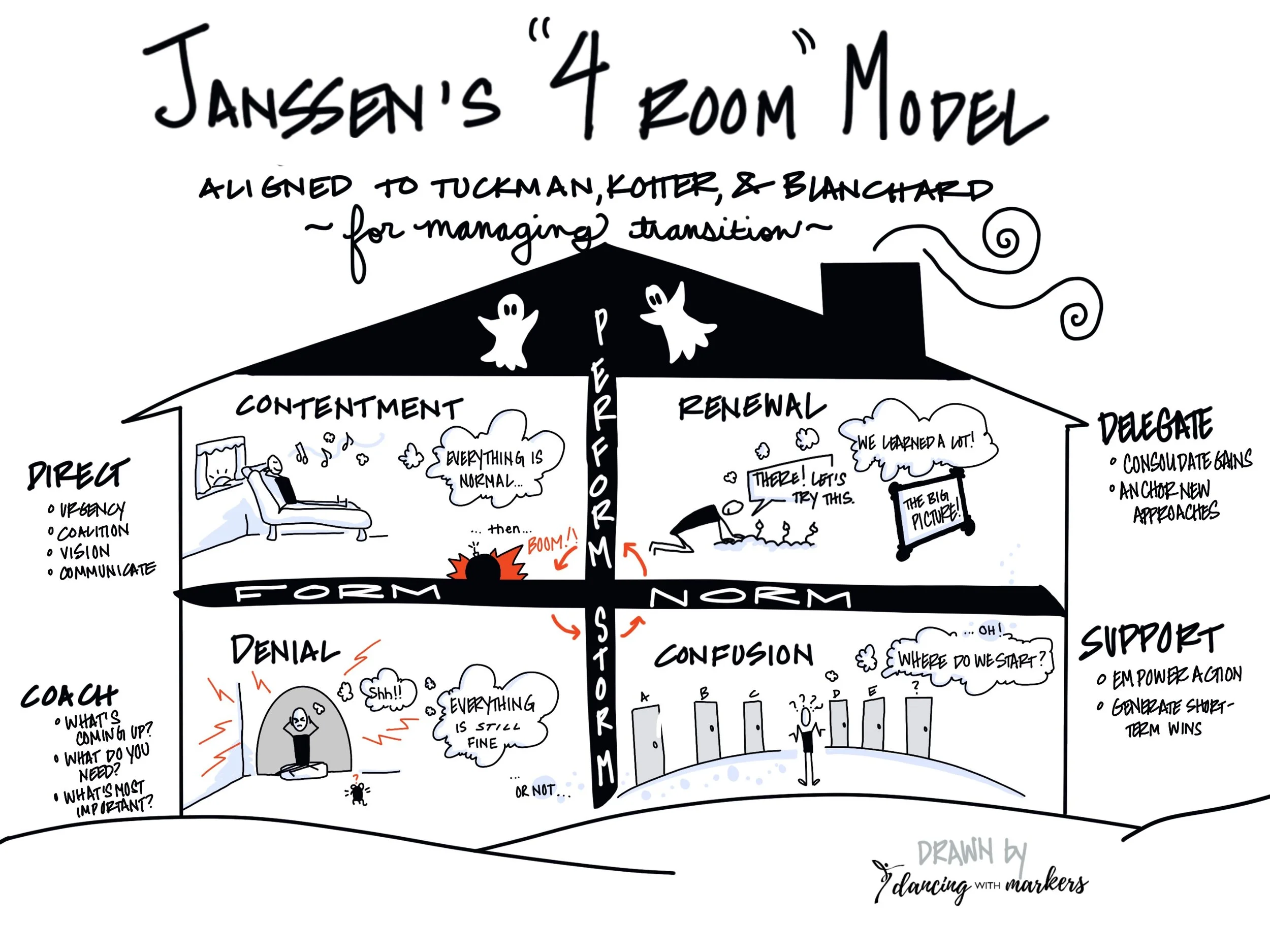
Weisbord and Janoff offer “The Four Rooms” model at the start of most meetings to normalize anxiety and confusion.
Invite the group to periodically notice where they are in the house. This emphasis on noticing makes it okay to feel confused and helps us see it as an opportunity to keep going.
For example, when someone points out a disagreement, the facilitator might ask, “Who else feels that way?” In seeking an ally for the dissenter, we legitimize concerns. We find empathy for the speaker within ourselves and invite the group to do the same.
In very heated disagreements, invite subgroups to form and have each group listen to the other. Use a “go around” anytime the group feels stuck. Weisbord and Janoff note that most of the time, a group moves on once it hears all views, and in many cases, someone offers an “integrating” both-and statement.
When a meeting is going off topic, state the obvious:
“We’ve spent a lot of time on this. Is there more to say, or can we move on?”
“Interesting. Can you share how you got there? How does this tie into [PURPOSE]?”
Bring the conversation back to the goals. Consult the group on where to go next. When no one knows, and the meeting is truly going nowhere, ask each person what they want to do. It is always in our power to end meetings that are not productive.
Get the Whole System in the Room
The “right” people have the expertise, authority, and information to act. This does not mean that the entire 5,000-person organization needs to attend, just a core group and relevant individuals who “ARE-IN” a position to act on behalf of the system.
ARE-IN stands for:
Authority to act
Resources - contacts, time, or money
Expertise on the issues
Information about the topic
Need to be involved, because they are affected by the outcome
“The more far-reaching the objective, the more need for a set of diverse players,” note Weisbord and Janoff.
Many are familiar with the classic metaphor of the blind men and the elephant. The lesson is that each man was partly right, but all were wrong. Nothing can be solved in isolation from the system. You can't change a system without exploring its relationship to the outside world (technology, money, customers, trends, etc.).
The whole system can be explored with visual tools such as:
Timelines
Mind-maps
Flow charts/process maps
The Grove’s Strategic Visioning toolkit is a model process to help groups find common ground and create action. Click here to purchase the templates for use in your PowerPoints and online whiteboards.
Seek Common Ground, Not Compromise
In common ground, the goal isn't agreement; it's understanding.
In compromise, someone wins, and someone loses. In common ground, participants talk long enough to clearly understand where they agree and where they do not. In doing so, “disagreement becomes a reality to live with, not a problem to solve.”
“People spend 80 percent of their time on 20 percent of the issues they cannot solve.”
With common ground as the goal, people are more likely to act quickly on things everyone wants. Weisbord and Janoff offer a few group structures that support seeking common ground. One is to have small groups create a flipchart of items they think everyone would agree on. Each small group reads their list aloud to the room. Other groups cross off any duplicates. The result is a de-duplicated list of areas of agreement and, usually, surprised faces when participants see how much agreement they really do have.
Match Time to Agenda
Time is our most precious commodity. Weisbord and Janoff suggest asking participants to help manage their own time. For example, when doing introductions, let groups know how much time they have. “In the next 10 minutes, we need to hear from everyone.” For long plenary discussions, they suggest asking a volunteer to signal the group every 10 minutes.
PRO TIP: Use the Principle of the Drinking Horn to encourage groups to share time.
Start promptly for those who arrive on time. For groups with notorious late arrivals, offer a “raggedy start,” a term coined by Ron Lippett, the founder of group dynamics. Have anyone present talk about what they are learning, sort information from previous sessions, and generate questions to cover during the meeting. Rachel Smith, a thought leader in online facilitation, calls this a “do now,” an activity participants do on arrival to create focus and value toward the meeting goals.
Shorter time frames work only when:
The agenda has a narrow focus
Many others have spent time working on the issues already
The objective is not controversial
When you facilitate online, plan to double or even triple the time you have. Check out this article published in Harvard Business Publishing, co-written with our partners at Lizard Brain and The Ringel Group for tips on structuring time in online classrooms. The techniques apply to meetings as well.
Know Your Role, and Make Sure Participants Know It Too
Know your role, and don’t accept a situation where you know you can’t succeed. In any one meeting, you might find yourself responsible for:
Process only (observe and comment)
Process and meeting management (manage the meeting but not the outcomes)
Process and content (provide expertise and advice)
Process, content and meeting management (responsible for process, content and outcomes; you may have formal authority, as well)
Make your role explicit to the group, and avoid surprising them by switching roles halfway through. At a minimum, let participants know when you change hats.
For example, if you are a manager who is also facilitating a project meeting, you might say, “I notice that we are having trouble understanding the goals of this project. I’m going to speak as the manager rather than the facilitator. I’d like to offer my perspective on the requirements and direction.”
When the meeting starts, agree with participants that your role is to:
Manage time and tasks
Make room for all views
Keep the goal in sight
Participants are responsible for:
Offering information and meaning
Managing their own behavior
Agreeing on common ground
Determining actions and next steps
Create Healthy Working Conditions
Choose spaces where participants may easily hear, see, interact, and move around. Spaces that open to the outdoors enable participants to take breaks outside. When ceilings are too high, they create echoes and can make it hard to hear. Larger spaces may need microphones.
Arrange seating that is conducive to the conversation you want to have:
Circles make it easier to interact
Tables can be more of a hindrance than help unless a workspace or place to write is necessary
Wheeled chairs make it easier for participants to reorganize
Avoid theatre seating and auditoriums at all costs
Translating this to a virtual environment, you need to assess:
Available technology (hardware and software)
Limitations of technology
Virtual readiness of the group
Virtual presentation materials (slides)
Virtual collaboration spaces (Mural, Miro, Google Docs, etc.)
Check out our blog, Using Online Whiteboards in Meetings for Beginners, for more guidance on choosing the right online meeting tool for your participants.
Whether we’re facilitating online or in person, Weisbord and Janoff’s wisdom helps us manage ourselves so we can be our best for those we serve.
As an Amazon Associate, we earn from qualifying purchases using links included in this blog.
Looking for more tips and guidance for leading inclusive, engaging, and productive meetings? Check out This Meeting Sucks, the podcast on a mission to end "sucky" meetings and bring meeting skills to the masses, one episode at a time.
Whether you’re a facilitator or participant, there’s a season for you. Listen wherever you get your podcasts.