The internet is crawling with meeting advice.
We're told that having an agenda will make our meetings better.
T
hat turning on cameras during video calls ensures everyone is engaged.
That using AI will make meetings more efficient.
And when the CEO of Southwest Airlines says “meetings are not work,” we are quick to join the “all meetings suck” bandwagon.
With all the noise about meetings, how can we separate genuine guidance from headline fluff?
Meeting science is a relatively new field. Pre-pandemic, there were only a handful of researchers exploring what makes meetings work and not work. The rapid shift to virtual work during the pandemic sparked greater interest in understanding meetings, prompting more researchers to examine one of the most overlooked parts of organizational life: the meeting.
Microsoft reported that weekly meeting time for the average Teams user rose 252% between February 2020 and February 2022. Yet, Steven Rogelberg noted that only 20% of leaders receive any training on how to run meetings.
Most organizations aren’t investigating their meeting practices. In Una McAlinden's 2026 study of Washington city leaders, 74% were satisfied with their leadership team meetings, but only 8% of teams regularly checked whether their meetings were actually moving work forward.
Meetings.
We dread them. Do we actually need them?
Meetings serve a core purpose in organizations by providing space to share information, resolve conflicts and miscommunications, improve processes, make informed decisions, move work forward, and plan for the future.
A 2026 study of more than 9,000 workers even found that meeting activity was positively associated with wage growth and on-the-job learning. That doesn't mean adding meetings will increase everyone's paycheck, but it certainly complicates the idea that meetings are simply wasted time. If these things didn’t happen in meetings, where would they happen? Would they happen at all?
The problem is not that we have meetings—it’s that we don’t know how to use them as a tool or, more importantly, as a measure of organizational health.
Where do you see organizational culture and values play out in real time? How do you track whether project work is moving forward? Where do you witness customer needs being met—or unmet? How do you know if team dynamics are leading to positive outcomes? All of these things play out in some kind of meeting. Meetings don't just reflect organizational culture; they help shape and reinforce it.
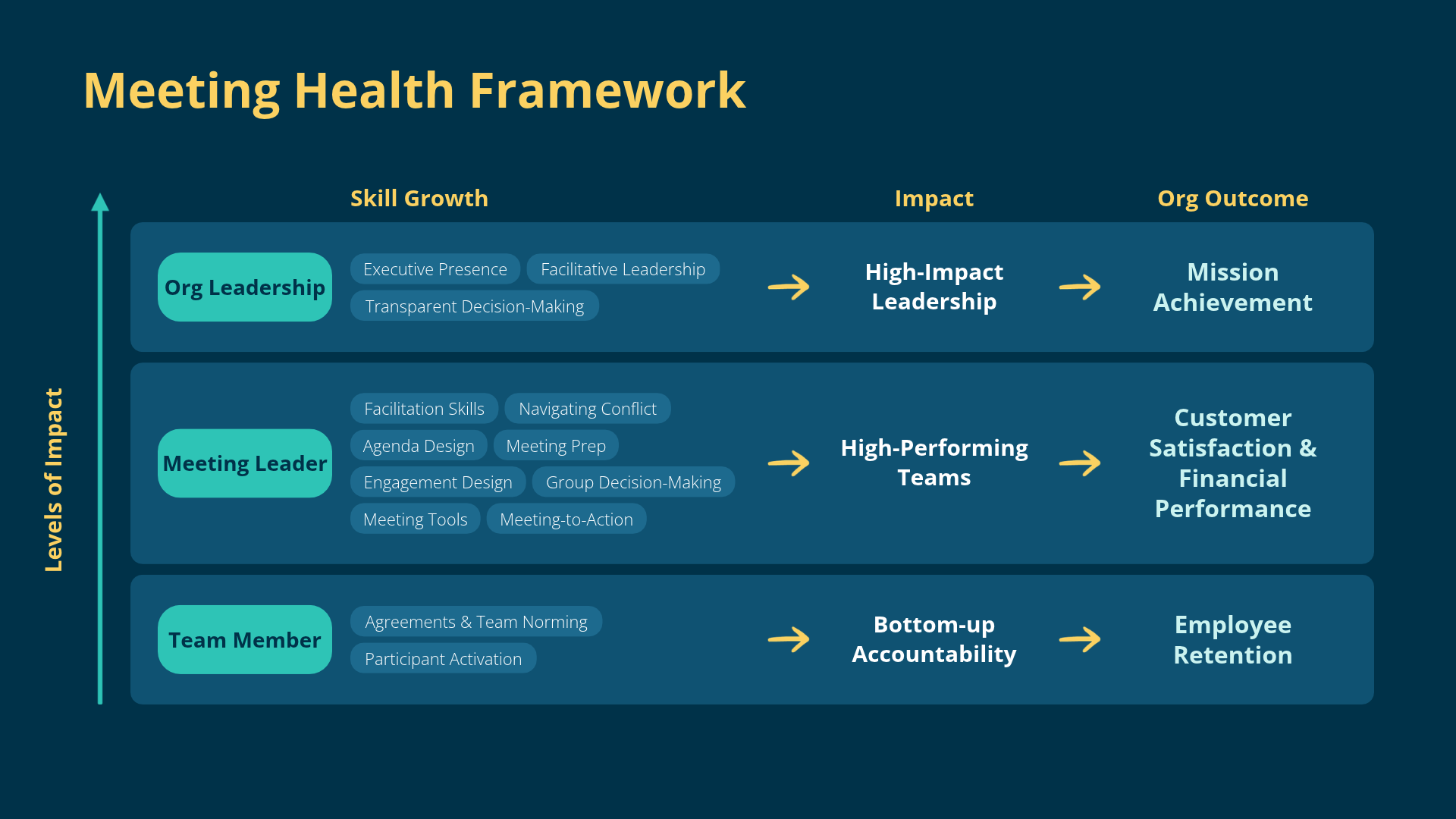
Meetings aren't just where we see organizational health in action; they're also where we can change it. Research has linked good and bad meeting behaviors to employee engagement and emotional exhaustion, well beyond the meeting itself.
By training executives in meeting presence and facilitative leadership, we can improve their overall leadership effectiveness.
By training meeting leaders to navigate conflict and group decision-making, we can build high-performing teams.
By teaching team members to engage actively and build team agreements, we can create bottom-up accountability.
Organizations don’t function without meetings, so how do we use meetings to drive organizational health and mission success?
11 Meeting Myths
11. No agenda, no attend-a!
If fixing meetings were as simple as creating an agenda, all meetings would be fixed by now. Agendas are great, but don't make meetings effective on their own.
Most of the time, when people say they want to see an agenda, what they are really asking for is the purpose or outcome of the meeting and why their attendance matters. The list of topics is less essential.
10. Attendees should be required to keep their camera on.
Body language and facial expressions can tell us a lot, especially when someone's words and expressions don't match. Albert Mehrabian and Susan Ferris’ 1967 study on how people interpret meaning found that only seven percent of meaning comes from text or word choice alone—the rest comes from facial expression and body language. However, pandemic research shows that Zoom fatigue is real.
Rebecca Hinds describes a field experiment in which one group was required to have cameras on for meetings, and the other wasn’t. They found that requiring cameras increased fatigue, particularly for women and newer employees, and fatigue was associated with less participation. So while having cameras on offers benefits, requiring them to be on 100% of the time may limit inclusion and participation.
9. Interrupting someone in a meeting is rude.

This comes up all the time—how do I interrupt someone who’s going on and on? No one wants to be rude. Procedural communication—a term coined by Allen and Reed to describe communication skills that support group process, a.k.a. “facilitation”—is part of what keeps meetings productive.
Research on team meetings found that these process-focused contributions help reduce unproductive behaviors. Meetings exist for a purpose, and that purpose is rarely about the person sucking up air time. Interrupting—when done politely—helps meetings serve their purpose.
🗣️ For practical tips, read our guide for politely interrupting in a meeting.
8. In-person meetings are always better.
Once the veil of the pandemic lifted and we began the trudge back to the office, in-person—and the dreaded “hybrid” meetings—made a comeback. In-person meetings have many benefits, especially when generating ideas. However, one study found that virtual groups were just as effective at selecting ideas, with some evidence that they may even do better. Not only that, in a study of a German public-sector organization, employees perceived virtual meetings as more effective, partly because participation was easier and people took turns speaking more consistently. The hand-raising feature alone creates more awareness when someone chimes in.
Virtual meetings can also give participants another way to contribute through chat, which may bring in voices we don't always hear aloud. Rather than assume all meetings are best done in person, consider what environment will best support the meeting’s outcomes.
7. This could have been an email.
If you have ever been the victim of a feedback request in email and had to hunt through dozens of replies to find the source email, you already know this myth is busted. But that doesn't mean everything belongs in a meeting either. Leigh Thompson’s work found that people brainstorming independently generated more ideas—and more original ones—than people brainstorming in groups. Group brainstorming can introduce conformity and groupthink, especially when a few dominant voices influence everyone else's ideas. You might gather ideas asynchronously in a shared document where all ideas are easy to see and not lost in email soup. Then meet to discuss or decide.
🤔 For help choosing a format, take our “Should we text, email, call or meet?” quiz.
6. If you want people to get something done, put a meeting on the calendar.
To build on “this could have been an email,” we see an ongoing pattern of defaulting to meetings as the go-to mode of communication. It makes sense. For many, if something isn’t on the calendar, it doesn’t get done. Carrie Goucher recommends intentionally designing how teams collaborate, including shared expectations for what belongs in meetings, chat, email, and other tools. For example, share routine updates asynchronously, collect feedback in a shared document, and save meetings for conversations that need real-time discussion or decisions. Ask yourself, “Is there a different way to accomplish what needs to happen?”
5. If I'm not leading the meeting, it's not my job to fix it.
Most organizations suffer from an innate accountability gap which stems from centuries of top-down, hierarchical organizational structures. We’re trained to point the finger up to the top when something isn’t working rather than own our part in it. Research on proactive verbal behavior in team meetings found that supportive responses to team members' suggestions supported greater meeting satisfaction and team performance. Participants share responsibility in meeting success. They can improve meetings simply by calling attention to someone who hasn’t spoken yet or making a kind observation that things may be getting off track.
🖥️ Join our MeetingMakers Community on Circle to watch our free webinar on PCMOM Participation Skills.
4. More AI means fewer meetings.
AI bots can attend meetings, handle routine questions, automate repeat tasks, and take care of some of the work we usually do ourselves. That means fewer meetings, right? Not necessarily. In a recent study at Anthropic, the median employee spent 20% more time in meetings than a year earlier, even as AI-agent use expanded. More automation doesn't eliminate the need for people to coordinate, debate, and decide. By all means, invite the robots, but don’t expect them to save your calendar from more meetings.
3. Cancel meetings to get more work done.
Meeting “cancel culture” is rampant, with organizations rolling out no-meeting days left and right. But is canceling meetings always the right move? Like any shift in a system, there are downstream impacts. Rebecca Hinds found that a complete meeting reset reclaimed more time than a conventional meeting audit. But most interesting is that roughly 70% of the time reclaimed in one reset came from shortening meetings rather than canceling them. The real opportunity may come from combining an occasional reset with regular team-level reviews to make sure meetings have the right amount of time.
2. More collaboration is always better.
Executive programs teach leaders that collaborative decision-making empowers teams and ensures that high-stakes decisions are well-informed, but more people in a meeting also means more relationships, inputs, and coordination to manage.
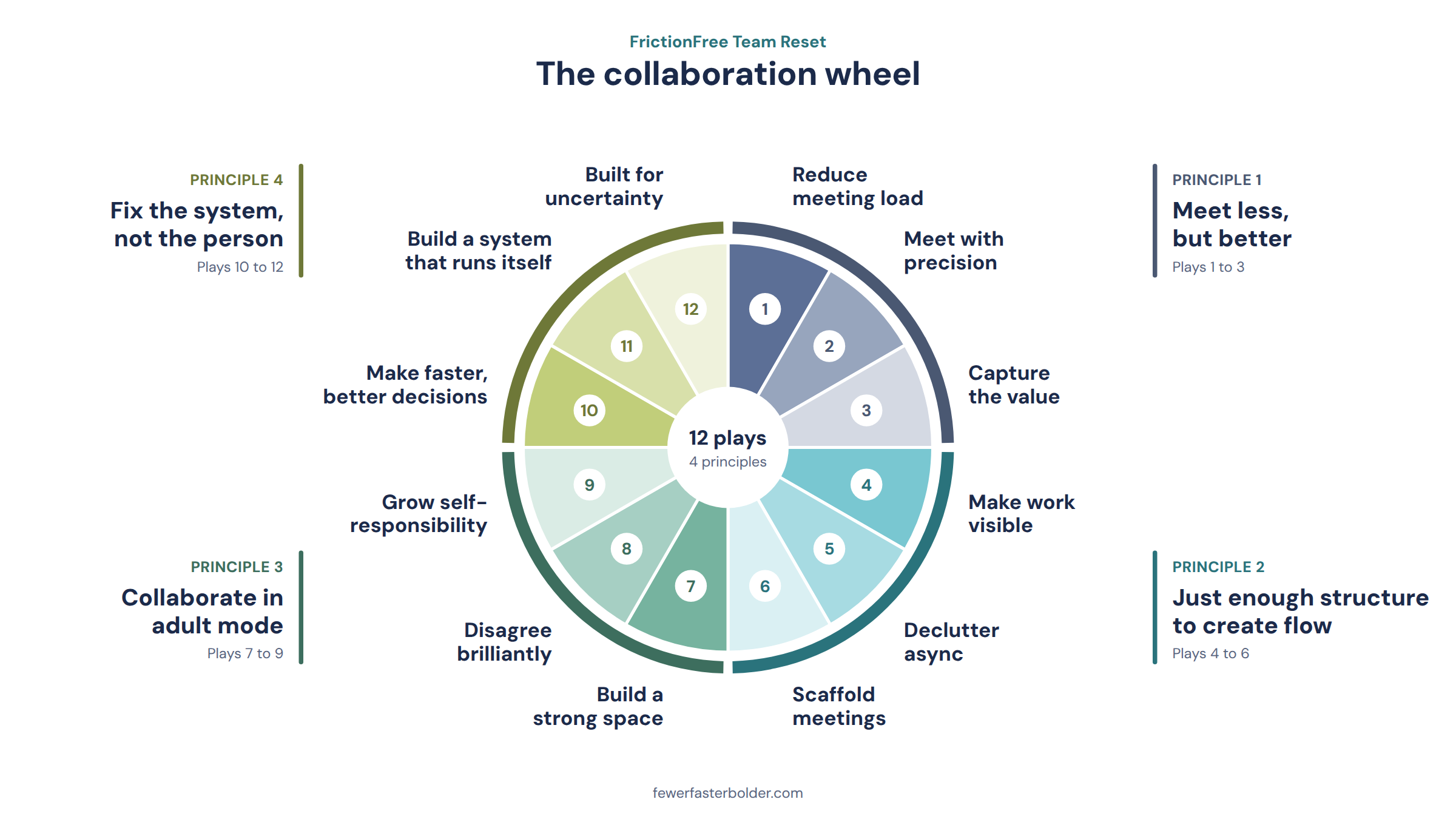
Carrie Goucher’s Collaboration Wheel
Collaboration has to be planned, lest it become “collabureaucracy,” a term Carrie Goucher uses to describe layers of collaboration that slow work rather than move it forward. Before adding someone to an invite, ask, “What input do I hope this person will provide?” If the answer is, “Listen for awareness,” their time may be better utilized if engaged separately (see Myth #7 for ideas). This enables only those who need to weigh to focus their energy more efficiently.
Goucher's Collaboration Wheel offers a way to look at how a team works together and where clearer decisions and ownership could reduce friction.
⚖️ For more on structuring decision-making in meetings, read our blog on decision-making and watch our decision-making webinar.
1. Everyone thinks meetings suck.
We all want to fit in—so when we hear our friends talk about sucky meetings, we’re likely to join in. This is exactly what Rogelberg, Scott, and Kello found: more than half the employees they surveyed complained publicly about meetings, yet in private surveys 42% rated meetings as good, another 17% rated them very good or excellent, and only 15% rated them poor or worse. That means there are a lot more people who appreciate the value of meetings than will admit it. . Our podcast, This Meeting Sucks, is titled ironically, with hopes that someone looking to commiserate about their sucky meetings will instead get a helpful dose of just-in-time learning for their next meeting.
If you’re ready to join the pledge to make meetings not suck, join our MeetingMakers Circle community, where you’ll find individuals in a different camp—one where we can make small changes to our meetings and see big results for our organizations.
Want to measure your meeting health?
Ask about our MeetingVitals Meeting Health Assessment.
We measure meeting health across nearly 20 meeting health principles and identify exactly where and what kind of intervention or training would best support your organization’s work and mission.
➡️ Reach out on our contact page.
References
The ideas explored here draw on a growing body of meeting science and the work of researchers and practitioners who have spent years studying how meetings shape organizations and the work experience. The primary sources cited in this article come from original or cited material in these resources:
Books
Joseph Allen and Karin Reed’s Running Effective Meetings for Dummies (2022)
Rebecca Hinds’ Your Best Meeting Ever (2026)
Elise Keith’s Where the Action Is (2018)
Studies, articles, and other research
Brucks and Levav’s study “Virtual Communication Curbs Creative Idea Generation” (2022)
Deming, Løken, Willén, and Xu’s study “Meetings” (2026), National Bureau of Economic Research
Carrie Goucher’s work on “collabureaucracy” and collaborative practices in her FrictionFree newsletter (2026)
Kreamer, Rogelberg, Tankelevitch, and Rintel’s “Virtual Voices: Exploring Individual Differences in Chat and Verbal Participation in Virtual Meetings” (2024)
Una McAlinden’s study “What Washington's Cities Say About Their Leadership Team Meetings” (2026)
Redlbacher and Hattke’s “How Virtual Meetings Stimulate Process Innovations in Organizations” (2024)
Rogelberg, Scott, and Kello’s study “The Science and Fiction of Meetings” (2007)
Steven Rogelberg’s Knowledge at Wharton interview, “Less Fluff, More Stuff: The Science of Productive Meetings” (2019)
Scott and Allen’s study “Toward an Organizational Theory of Meetings” (2023)
Leigh Thompson’s research on individual brainstorming and originality (discussed in Hinds, 2026)
Wei, Hwang, Zainal, and Zhu’s “Trust, Team Effectiveness, and Strategies: A Comparative Study between Virtual and Face-to-Face Teams” (2024)